
Quick Summary
When an electric gate not closing creates security and safety risks, the malfunction is usually triggered by blocked photo-eye sensors, track obstructions, or control board errors rather than a total motor failure. While basic optical lens cleaning and debris removal can resolve simple issues, Ironworks Gate Co. recommends professional diagnostics for complex wiring, force settings, and structural binding to maintain safety standards. Readers will learn how to safely perform initial diagnostic checks and when to schedule a free on-site gate assessment or call for same-day emergency repair service.
Electric Gate Not Closing: Fast Fixes and Pro Guide
When an electric gate refuses to close, it can create an access-control and safety concern. While property owners often suspect a dead motor when a gate is stuck open, the opener is usually responding to safety inputs or mechanical issues that prevent movement. Forcing the gate or bypassing safety features is unsafe. Historical reporting from the U.S. Consumer Product Safety Commission (CPSC) documented serious injuries and fatalities involving automatic gates, including child fatalities, without implying that failure to close caused a specific share of incidents. Never bypass or disable entrapment-protection devices. Note that no neutral-source dataset provides a verified 2025 national count, percentage, or failure rate for electric gates that fail to close.[1]
Closing failures can stem from a variety of mechanical, electrical, or sensor issues. Review the diagnostic steps below to safely identify potential causes when your gate remains open. See also Automatic Gate Troubleshooting – Call Now-10% Off – Same-Day Service – Free Estimate.
Fast Diagnosis: Why Your Electric Gate Is Not Closing
Fast Diagnosis: Why Your Electric Gate Is Not Closing in brief: An electric gate that opens but will not close is often responding to safety or resistance signals. Blocked or misaligned sensors are one possible cause, along with obstructions, binding, safety-edge faults, wiring problems, or control faults. When the gate opener senses physical resistance or an interrupted optical beam, it holds the gate open to prevent property damage or injury.
Automatic gate openers are engineered to stop and reverse whenever they detect a safety interruption or mechanical resistance.
Quick Safety and Diagnostic Checklist
- Keep clear: Keep all people, pets, and objects clear of the gate travel path.
- Visual check: Look for debris, dirt, or visible obstructions along the gate path or sensors.
- Model-specific guidance: Consult the model-specific manual for approved safety and operating instructions.
UL 325 is associated with safety requirements for automated gate and door operators. UL Standards & Engagement reported a greater-than-50% decrease in certain measures as a share of all garage-door injuries. When troubleshooting, always inspect your gate safely and avoid altering safety circuits, as recommended by Ironworks Gate Co. If realignment and basic cleaning do not solve the problem, obtain a professional inspection from a qualified technician.[3]
Safety and Precautions Before Troubleshooting Your Gate
Before inspecting your gate, prioritize safety. Keep people and objects clear of the moving gate path, and switch off power before inspecting connections. Multimeter testing, electrical-enclosure work, wiring diagnosis, force-setting changes, and structural repairs should not be treated as general homeowner tasks. Obtain qualified service for electrical, structural, or persistent safety faults.
Safe Testing Guidelines
- Keep the area clear: Ensure no bystanders or vehicles are near the gate during inspection.
- Switch off power: Turn off electrical power before inspecting any physical connections.
- Consult the manual: Check the model-specific manual for system-specific safety warnings.
- Clean sensor lenses: Use a clean microfiber cloth to gently remove dirt or debris from photo-eye lenses.
Step 1: Clean and Align the Photo-Eye Safety Sensors
Blocked or misaligned sensors are one possible cause when an electric gate will not close, along with obstructions, binding, safety-edge faults, wiring problems, or control faults. Safety sensors project an optical beam across the opening, and an interrupted beam signals the operator to keep the gate open.
Clearing Physical Blockages
- Wipe the sensor lenses with a clean microfiber cloth to remove dirt, cobwebs, and debris.
- Cut back tall grass, weeds, or low-hanging branches that may obstruct the optical beam path.
Realigning Optical Sensors
If sensors have been shifted out of position, clean and realign them following the manufacturer instructions. If the sensors do not respond or proper alignment cannot be restored, professional service is recommended.
Step 2: Check for Track Obstructions and Mechanical Binding
If sensors are clean and aligned, the opener may be detecting physical drag or mechanical resistance along the gate path.
Inspecting Tracks and Rollers
- Inspect sliding tracks and guide rollers, clearing away packed dirt, gravel, or debris.
- Check swing hinges and mechanical hardware for visible signs of damage, wear, or physical binding.
If physical binding, post deflection, or structural alignment issues are detected, obtain professional inspection and repair rather than attempting structural modifications.
Step 3: Resetting the Gate Opener
Need electric gate not closing?
We’re available now - call for a fast, free estimate.
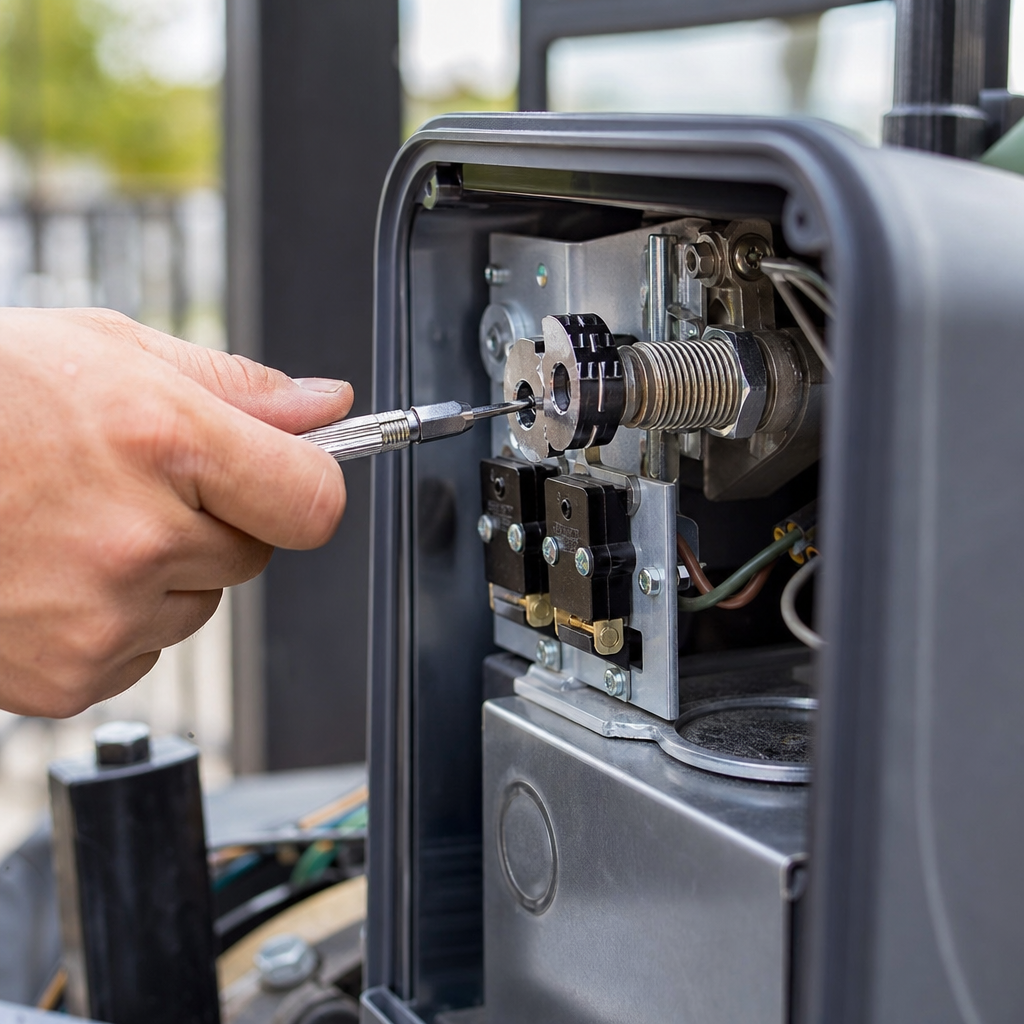
Control boards may occasionally enter an error state following a power interruption or system overload.
Reset Procedures
Reset procedures vary by model and must follow the owner or installation manual. Always consult your model-specific documentation for the approved power-cycling and reset sequence.
Addressing Persistent Faults
If the gate opener does not resume normal operation after an approved reset, discontinue use and contact a qualified technician, such as the team at Ironworks Gate Co., to diagnose control-board or accessory issues.
Step 4: Limit Switch and Force Setting Considerations
Travel limits and force settings control how far the gate moves and the level of resistance allowed before the opener stops or reverses.
Consult your model-specific manual for proper travel limit adjustments. Never adjust force settings as a workaround for mechanical drag or binding, as force settings are critical to entrapment protection. Any adjustment to force settings or safety limits should be handled by a qualified technician.
Step 5: Wiring and Access Controls
External access devices, including keypads, push buttons, loop detectors, and intercoms, can hold a gate open if a relay sticks or an electrical fault occurs. Because testing wiring, working within electrical enclosures, and diagnosing control loops involve electrical hazards, these tasks require qualified service.
Step 6: Know When to Call a Professional Gate Technician
While clearing basic sensor obstructions and visual inspections are straightforward, complex repairs require experienced technicians. Seek professional service for:
- Multimeter testing, wiring diagnosis, and any electrical-enclosure work.
- Structural post movement, hinge welding, or track realignment.
- Force-setting adjustments and control-board replacements.
- Persistent safety-circuit or entrapment-protection faults.
Frequently Asked Questions About Electric Gate Repair
Common Troubleshooting and Service Inquiries
Why does my gate start closing and immediately reverse back open?
When a gate reverses mid-cycle, the opener is typically detecting mechanical resistance or receiving a safety input signal. Blocked or misaligned sensors are one possible cause, along with obstructions, track binding, worn hinges, or control faults. Ensure the gate path is clear, clean the sensor lenses, and consult the model-specific manual.[2]
What safety steps should I take if my gate will not close?
A gate that will not close creates an access-control and safety concern. Keep people and objects clear of the gate path, switch off power before inspecting connections, and never bypass or disable entrapment-protection devices.[4]
What should I do if a system reset does not fix the problem?
Reset procedures vary by model and must follow the owner or installation manual. If the gate continues to malfunction after following the manufacturer reset procedure, obtain a professional inspection from a qualified technician, such as Ironworks Gate Co.
Need electric gate not closing?
We’re available now - call for a fast, free estimate.
Sources
- 32346 – govinfo.gov (2018)
- Final Rule – Safety Standard for Gates and Enclosures – CPSC – cpsc.gov (2020)
- National Electronic Injury Surveillance System (NEISS) – CPSC.gov – cpsc.gov
- CHAPTER SIX Automatic Electric Gates – nwfdaz.gov
Related reading: Gate Hinge Repair | Call Now-10% Off | On-Site in 60 Minutes | Free Estimate
Related reading: How to Fix Sagging Gate | Call Now-10% Off | Same-Day Service | Free Estimate
Related reading: Sliding Gate Repair – Call Now-10% Off – On-Site in 60 Minutes – Free Estimate
Frequently Asked Questions
Can bright sunlight or weather conditions prevent an electric gate from closing?
Yes, direct sunlight blinding the photo-eye receiver or condensation inside the lens housing can disrupt the optical beam, causing the gate operator to detect a false obstacle. If cleaning the lens and shading the sensor does not restore function, Ironworks Gate Co. can realign the hardware or install sun-shielded optical units.
How can I manually close and secure my gate if it is stuck open?
You can disengage the opener using the motor's manual release key or lever, which frees the drive mechanism so you can physically push or slide the gate shut. After manually securing the gate with a chain or latch, contact Ironworks Gate Co. for same-day emergency repair service to restore automated operation.
Can a faulty underground exit loop keep an electric gate open indefinitely?
A damaged or shorted in-ground loop detector can continuously send a 'vehicle present' signal to the control board, preventing the close cycle from initiating. Diagnosing subterranean loop wiring and relay faults requires specialized electrical testing, which Ironworks Gate Co. provides during a free on-site gate assessment.
About the author
 |
Megan Sullivan Megan Sullivan is a technical writer specializing in property maintenance and access control systems, with over six years of experience in the home services sector. She holds a B.A. in Technical Communication from the University of North Texas and focuses on providing clear, practical advice on gate repair and pricing for Texas homeowners. Her work emphasizes transparent solutions and preventive maintenance strategies. |
Gate not opening, off track, or opener dead?
We’re available now - call for a fast, free estimate.
Call Now - Free Estimate