
Quick Summary
Effective sliding gate repair requires addressing the root causes of mechanical drag, such as sagging tracks and worn rollers, which frequently cause drive motors to stall and create dangerous derailment hazards. Ironworks Gate Co. emphasizes that isolating physical rolling resistance through manual travel testing is the most critical first step before servicing electrical components or replacing hardware. Readers will learn how to safely realign ground tracks, install sealed-bearing V-groove rollers, and calibrate safety limits, with Ironworks Gate Co. available for comprehensive diagnostics and same-day emergency repairs.
Sliding Gate Repair: Fix Sagging Tracks and Stalled Motors
When an automatic sliding gate drags along the driveway or stops halfway through its cycle, the operator is often reacting to mechanical drag. Shifting ground conditions, foundation movement, and wear can misalign tracks and rollers, binding the gate leaf and impeding normal operation.[3]
Powered gates require comprehensive risk assessment, appropriate design, ongoing maintenance, and regular safety checks in compliance with applicable powered gate safety standards. Addressing underlying track alignment and mechanical wear allows the system to move freely and reduces unnecessary strain on drive components.[4] See also Automatic Gate Troubleshooting – Call Now-10% Off – Same-Day Service – Free Estimate.
Diagnostic Checklist and Safety Essentials
As technicians at Ironworks Gate Co. point out, sliding gate repair requires separating physical track drag from electrical drive failures. Heavy gate panels present serious mechanical hazards if they jump their track or lack proper stops. In fact, a California OSHA review cited by ASTM documented 47 work-related accidents between 1990 and 2024 involving horizontal sliding gates that derailed and fell, leading to 35 serious injuries and 12 fatalities. International regulators, including Australia’s WorkSafe Victoria and the UK’s Health and Safety Executive (HSE), similarly stress that powered sliding gates require routine physical inspections, reliable travel stops, and verified anti-fall hardware to prevent collapse.[1]
What to Have on Hand Before Troubleshooting
- Digital Multimeter: To test line voltage and control circuits.
- 4-Foot Level and Pry Bar: To check track grade, alignment, and roller assemblies.
- Hydraulic Toe Jack: To lift gate frames safely without bending rails.
- Socket Set, Wrenches, and Grease Gun: For adjusting brackets, replacing rollers, and servicing guide assemblies.
Step 1: Disengage the Motor and Test Manual Travel
The fastest way to isolate a drive issue during sliding gate repair is to disconnect the drive system and test gate movement manually.
Releasing the Drive Mechanism
Follow proper lockout-tagout procedures and turn off power to the operator at the breaker or disconnect switch before performing work. Unlock the manual release on the motor housing, or disconnect the drive connection from the gate frame. Once disconnected, the gate should roll along the track with minimal resistance.
Checking Rolling Resistance
- Walk the gate slowly from the fully open position to the fully closed position.
- Feel for specific spots where the gate resists movement, binds, or drops into low points.
- Listen for metal-on-metal grinding, squealing roller bearings, or scraping against the track or ground.
If significant physical force is required to move the gate by hand, the drive system will struggle as well. If the gate rolls smoothly by hand, specialists at Ironworks Gate Co. recommend focusing troubleshooting on drive components, limit settings, and safety circuits.
Step 2: Inspect the Ground Track for Misalignment
Ground-mounted tracks can shift over time if the supporting surface settles or moves, creating uneven track sections and roller binding.
Spotting Track Misalignment
Sight down the length of the track from ground level. Look for:
- Sections where anchor bolts are loose or damaged.
- Gaps between the bottom of the track and the mounting surface.
- Pinch points where track deviation causes roller flanges to bind.
Re-anchoring and Leveling the Track
- Mark high and low points: Use a string line or level across the travel span to identify elevation changes.
- Shim low sections: Loosen loose fasteners, lift depressed track spans, and insert suitable shims beneath the track base.
- Set new concrete anchors: Drill fresh holes and install appropriate concrete anchors to secure loose sections.
- Address foundation damage: If the supporting slab or footing has failed, the affected section may require structural repair or repouring.
Step 3: Replace Damaged V-Groove Rollers and Guide Rollers
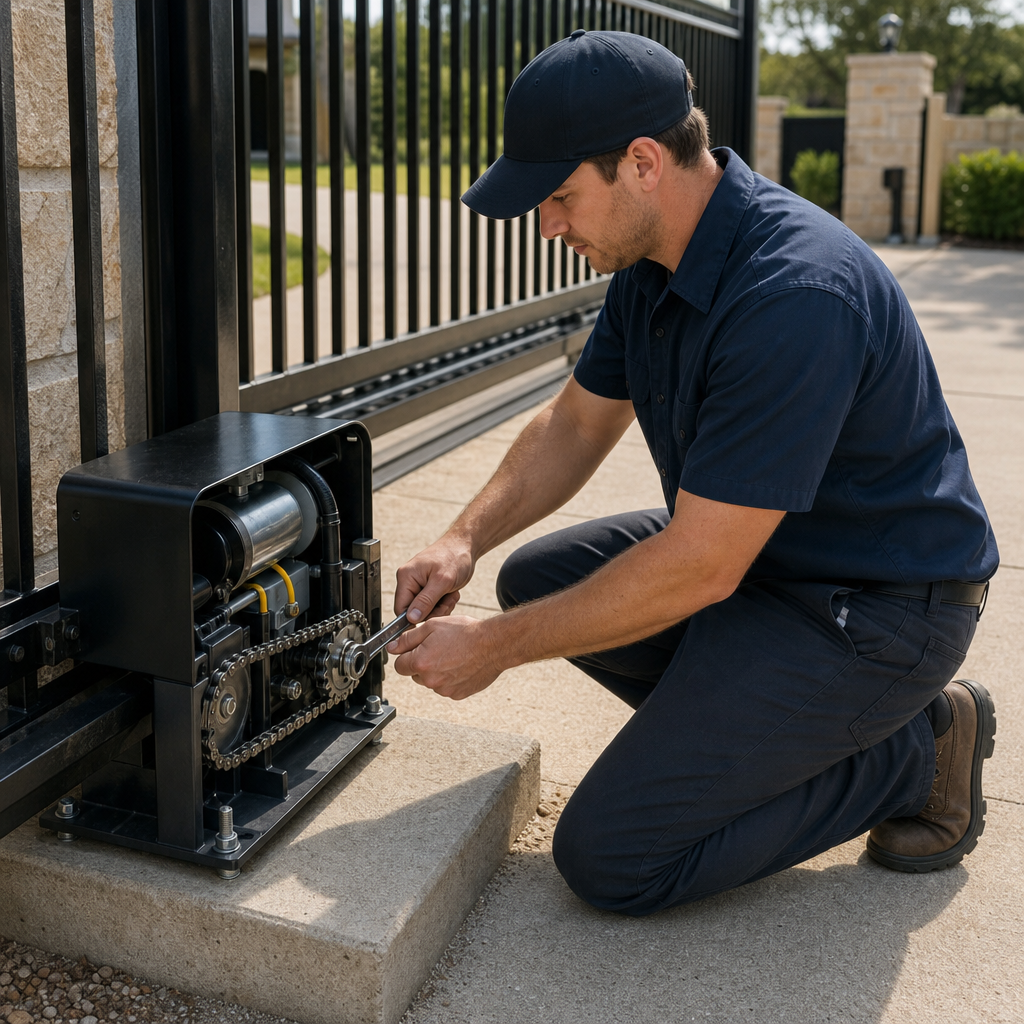
When a track shifts out of alignment, uneven load distribution can damage roller bearings, leading to flat spots and excessive rolling resistance.
Replacing Seized Lower Rollers
- Set a hydraulic toe jack under the bottom frame tube near the roller box.
- Raise the gate leaf just high enough to take weight off the wheel while keeping the top rail safely retained within the upper guide brackets.
- Unbolt the through-axle bolt and remove the old roller assembly.
- Slide in a replacement roller assembly with sealed bearings suitable for the gate’s weight and usage, as recommended by Ironworks Gate Co.
- Secure the axle hardware, ensuring the wheel spins freely without binding.
Aligning Top Guide Rollers
The upper guide rollers keep the gate vertical as it slides. Adjust the guide roller brackets so they hold the gate plumb without creating excessive friction against the top rail, ensuring the panel cannot disengage from its guides.
Step 4: Troubleshoot the Drive System and Opener
Once the gate moves smoothly on its track, inspect the drive components and operator.
Checking Drive Chain and Mechanical Components
Inspect the drive chain or belt for proper tension and alignment. An excessively loose or tight drive connection can cause jerky travel or place undue stress on output shafts and bearings. Check drive sprockets for hooked or worn teeth, and replace damaged hardware as needed.
Step 5: Align Safety Sensors and Program Travel Limits
Powered gate installations require functional safety devices and monitored entrapment protection in compliance with powered gate safety standards.[5]
Aligning Monitored Sensors
- Inspect sensor housings and clean optical lenses of dirt and debris.
- Adjust sensor brackets until steady indicator lights confirm reliable signal alignment.
- Install protective hoods or sun shields if direct sunlight interferes with optical receivers.
Setting Travel Limits and Physical End Stops
Verify that positive physical end stops are firmly installed at both ends of travel to prevent the gate panel from over-traveling or derailing. According to installation guidelines from Ironworks Gate Co., program limit and slowdown points so the gate comes to a controlled stop before reaching the physical end stops. Test obstruction sensing and safety reverse functions to ensure compliant operation.[2]
Frequently Asked Questions
Why has my electric sliding gate stopped opening or closing?
Common causes include misaligned safety sensors, power supply interruptions, tripped circuit breakers, or mechanical binding along the track. When a motor operates but fails to move the gate, disconnected drive mechanisms, worn drive components, or seized rollers are common contributing factors.
How do you fix a sliding driveway gate that is off track?
First, isolate power using proper lockout-tagout procedures and disconnect the drive system. Use a hydraulic toe jack placed safely under the structural frame to lift the panel. Clear dirt and debris from the track and wheels, then lower the roller back onto the rail. Before restoring operation, inspect the gate for bent guide rollers, missing end stops, or track misalignments that may have caused the derailment.
Can a damaged sliding gate track or roller be replaced?
Yes. Bottom rollers can be unbolted and replaced with heavy-duty sealed-bearing units. Damaged track sections can be cut out and replaced with matching track anchored securely to the foundation.
What are the common signs of sliding gate motor failure?
Warning signs include motors that hum without moving the gate, erratic stopping or reversing during travel, unusual gearbox noises, or control board error indications. Excessive mechanical drag along the track often contributes to operator overheating and failure.
How should sliding gate tracks and rollers be maintained?
Powered gates require routine maintenance and safety checks to remain compliant with safety standards. According to Ironworks Gate Co., maintenance includes clearing dirt and debris from the ground track, checking drive alignment and tension, inspecting guide rollers and end stops, and verifying that the gate operates smoothly by hand when disengaged.
Sources
- [PDF] Petition File No. 605 Cal/OSHA Evaluation – dir.ca.gov (2024)
- Sliding industrial gates | WorkSafe Victoria – worksafe.vic.gov.au (2025)
- Final Rule – Safety Standard for Gates and Enclosures – CPSC – cpsc.gov
- Legal responsibilities – hse.gov.uk (2008)
- ANSI/CAN/UL 325 and Gate Installations – dasma.com (2016)
Related reading: Electric Gate Opener Troubleshooting – Call Now-10% Off – Same-Day Service – Free Estimate
Related reading: How to Manually Open Electric Gate | Call Now-10% Off | Same-Day Service | Free Estimate
Frequently Asked Questions
What should I do if my sliding gate has derailed and poses an immediate falling hazard?
Immediately disconnect power to the operator and clear the area around the panel to prevent dangerous structural collapse. Contact Ironworks Gate Co. for same-day emergency sliding gate repair so technicians can safely secure the heavy gate leaf, reset upper guide rollers, and install positive travel stops.
How can I tell if sliding gate drag is caused by foundation shifting rather than motor failure?
If the gate consistently binds or scrapes at specific points along its travel path while moving smoothly elsewhere, ground settling has likely displaced the track. Ironworks Gate Co. offers free on-site sliding gate assessments across the Rockwall area to measure track grade, shim depressed spans, and repair damaged concrete anchors.
How often do V-groove sliding gate rollers need to be replaced?
Heavy-duty sealed-bearing rollers generally last five to ten years, though uneven tracks and heavy daily cycles can cause premature bearing failure or flat spots. Technicians at Ironworks Gate Co. can inspect roller wear during regular diagnostics and install commercial-grade replacement hardware to prevent drive motor burnout.
About the author
 |
Megan Sullivan Megan Sullivan is a technical writer specializing in property maintenance and access control systems, with over six years of experience in the home services sector. She holds a B.A. in Technical Communication from the University of North Texas and focuses on providing clear, practical advice on gate repair and pricing for Texas homeowners. Her work emphasizes transparent solutions and preventive maintenance strategies. |
Gate not opening, off track, or opener dead?
We’re available now - call for a fast, free estimate.
Call Now - Free Estimate