
Quick Summary
When driveway and security gates begin to drag, learning how to fix a sagging gate requires identifying structural root causes like leaning posts, expansive soil shifts, and hinge wear to prevent severe mechanical strain and derailment hazards. Rather than applying temporary turnbuckle patches or pushing for costly full replacements, Ironworks Gate Co. resolves sagging gates by stabilizing underground footings and realigning load-bearing hinge posts at the structural root. After learning how to diagnose alignment issues safely, readers can contact Ironworks Gate Co. to schedule a free on-site gate assessment or call for reliable same-day sagging gate repair.
Fix Sagging Gate: Fast Repair & Post Leveling Guide
When a driveway or security gate starts dragging across the pavement, refusing to latch, or binding mid-swing, the instinct is often to look for a quick adjustment. A sagging gate is rarely just a cosmetic inconvenience. Sagging can interfere with gate operation, increase mechanical strain, and create safety risks. Professional gate repair labor generally runs approximately $50-$150 per hour, with typical automatic-gate repairs averaging between $550 and $1,500, depending on the problem and location.[4]
Putting off repairs or applying temporary fixes can lead to serious risks. From 1990 to 2024, 47 California workplace accidents involved fence gates derailing and falling; 35 workers were injured and 12 died. Derailments and falling gates can cause severe physical trauma, including fractures, spinal injuries, and internal bleeding. According to specialists at Ironworks Gate Co., restoring proper alignment requires identifying whether the drop stems from hinge wear, frame deflection, or shifting support posts below the soil line.[1] See also Automatic Gate Troubleshooting – Call Now-10% Off – Same-Day Service – Free Estimate.
Fix Sagging Gate Fast: Quick Diagnostic and Action Guide
Quick Diagnostic Summary (General Trade Guidance): To assess a sagging gate, first ensure the leaf is supported to relieve mechanical tension. As general trade guidance, evaluate whether the sag originates from loose hinge components, frame racking, or a leaning post. Always secure the gate and stop work when structural or automated-system hazards are present. Minor adjustments may be manageable, while heavy gates, structural damage, motors, wiring, and high-voltage components should be handled by a qualified professional.[3]
As general trade guidance, the following three-point check is commonly used to inspect gate alignment:
- Unload the weight: Place wood shims or a support block under the swinging end of the gate to relieve downward tension on the mounting hardware.
- Isolate hinge play: Grip the gate frame near the top hinge and lift gently to check for independent movement between the hinge and the post.
- Check the post with a level: Place a level against the face and side of the hinge post to determine if the post itself is out of plumb.
Root Causes of Gate Sag
Note: The following mechanical and environmental explanations represent general trade guidance.
1. Expansive Soil and Sub-Surface Post Deflection (General Trade Guidance)
In regions with expansive soils, moisture shifts can cause ground movement that puts lateral force on concrete footings. Over time, an inadequate footing may allow the post to tilt, which translates to a noticeable drop at the latch end of a swing gate.
2. Anti-Sag Kits and Caster Wheels (General Trade Guidance)
While a turnbuckle brace can help stiffen a racked wooden frame, it does not correct a leaning post or worn hinges. On automated setups, helper wheels can introduce additional resistance, and sagging can interfere with gate operation, increase mechanical strain, and create safety risks.
3. Hinge Wear vs. Frame Racking (General Trade Guidance)
As noted by Ironworks Gate Co., heavy gates place constant loads on upper hinge assemblies, where wear can develop over time. On lighter gates, frames may lose squareness over time, causing the latch side to drop even if the post remains vertical.
Step-by-Step: How to Address a Sagging Gate Safely (General Guidance)
Warning: Always secure the gate properly to prevent falling. Stop work and consult a qualified professional if structural hazards or automated-system issues are present. Minor adjustments may be manageable, while heavy gates, structural damage, motors, wiring, and high-voltage components should be handled by a qualified professional.
The following procedures reflect general trade guidance for assessing and stabilizing a gate leaf:
- Step 1: Secure and Support the Gate Leaf: Never work on a gate while its full weight hangs unsupported. Secure and support the leaf to prevent it from dropping or tipping over during assessment.
- Step 2: Inspect Hardware and Fasteners: Inspect hinge pins, mounting hardware, and connections for wear, looseness, or damage.
- Step 3: Realign Adjustable Hinges: If the gate is equipped with adjustable hinges, general trade practice involves adjusting the threaded hardware to draw the top of the gate closer to the post to elevate the latch side.
- Step 4: Evaluate Frame Bracing: On lightweight frames suffering from racking, adding diagonal tension bracing can help pull the frame back into square. Structural metal frame repairs should be referred to a qualified professional such as Ironworks Gate Co.
- Step 5: Reset Travel Limits and Stops: Once properly aligned, ensure travel stops and limits are correctly positioned for safe operation.
Core Components: Hinges, Guide Rollers, and Positive Stops
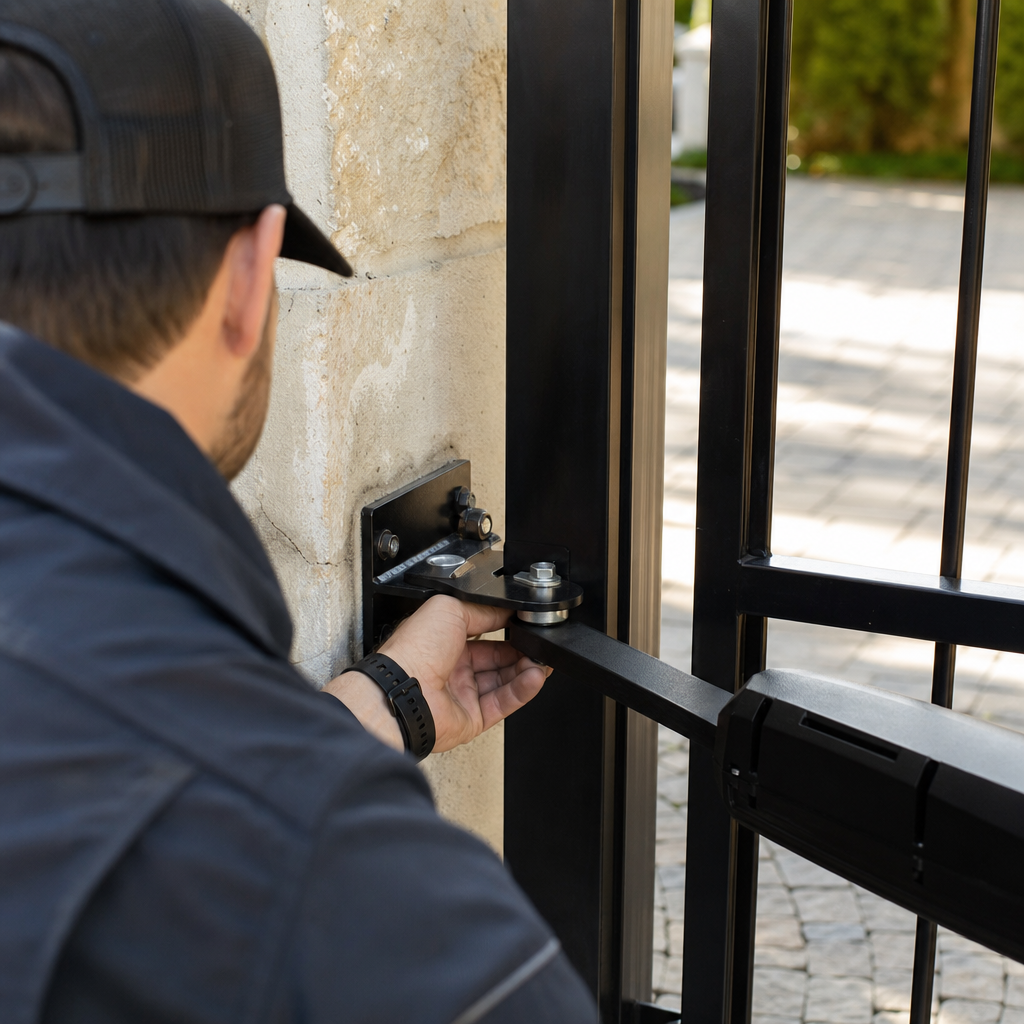
Safe gate operation depends on a coordinated system of structural and mechanical components working together to prevent derailment.
| Component | Common Failure Point (General Trade Guidance) | Corrective Action (General Trade Guidance) |
|---|---|---|
| Hinge Assemblies | Worn bearings, loose mounting hardware, cracked attachment points. | Service or replace hinges with hardware rated for gate leaf weight. |
| Support Posts | Post leaning from inadequate footings or shifting ground. | Stabilize post or excavate and reset footings professionally. |
| Positive Stops | Missing, damaged, or bypassed due to misalignment. | Install or adjust physical positive stops to prevent over-travel. |
| Guide Rollers | Seized movement, missing protective covers, binding. | Service rollers and maintain guarded covers to eliminate pinch points. |
Manual Slide Gate Safety Standards
ASTM guidance for manual slide gates includes positive stops, guarded exposed rollers, fall protection beyond 45 degrees when detached, and prevention of gravity-driven movement. The Consumer Product Safety Commission (CPSC) has identified missing or failed end-stops or positive stops as a recurring factor in gate tipping accidents.[2]
Automated Gate Safety Measures
Supported safety measures for automatic gates include obstruction sensing, secondary sensing, elimination of pinch points, guarded exposed rollers, and controls positioned so users can see the gate while operating it. When a gate sags, friction and misalignment can interfere with gate operation, increase mechanical strain, and create safety risks.[5]
Automatic Gate Systems and Operator Alignment
As technicians at Ironworks Gate Co. point out, automatic gate operators are engineered to move a properly balanced, free-moving gate. Sagging can interfere with gate operation, increase mechanical strain, and create safety risks.
When support posts lean or alignment is compromised, the operator encounters unintended resistance. This extra strain can trigger obstruction sensors prematurely, causing false reversals, or lead to increased mechanical wear across the drive system.
What Does Fixing a Sagging Gate Cost?
Professional gate repair labor generally costs approximately $50-$150 per hour, and typical automatic-gate repairs range from $550 to $1,500, depending on the problem and location.
Minor adjustments may be manageable for DIY repair, while heavy gates, structural damage, motors, wiring, and high-voltage components should be handled by a qualified professional.
Frequently Asked Questions About Sagging Gate Repair
Why is my gate sagging and dragging on the ground?
As general trade guidance, a gate may drag on the ground when hinges wear out, the frame loses squareness (racking), or the support post tilts out of plumb due to ground movement or settling.
How do you fix a sagging metal or iron gate without replacing it?
As general trade guidance, if the post is plumb, adjustable hinges can be adjusted to help lift the latch side. For non-adjustable hardware or structural issues, a qualified professional such as Ironworks Gate Co. should evaluate or replace worn components. Always stop work and seek professional assistance if structural hazards are present.
Can an anti-sag gate kit or turnbuckle fix a heavy gate?
As general trade guidance, a turnbuckle brace can help pull a lightweight racked frame back into square, but it will not correct a leaning support post, heavy structural damage, or worn hinge hardware.
How do you adjust or reinforce hinges on a sagging gate?
As general trade guidance, always support the gate leaf securely before inspecting hardware. Minor adjustments on adjustable hinges may be manageable, but heavy gates, structural damage, and automated components should be serviced by a qualified professional.
When should a sagging gate be repaired versus completely replaced?
As general trade guidance, minor adjustments and component repairs may be sufficient if the overall structure remains sound. However, if there is severe structural damage, widespread frame failure, or significant safety hazards, comprehensive professional service or replacement is recommended.
Sources
- [PDF] 2024-11-20-COPF-CODD-Hummingbird-Alliance-Meeting-Log.pdf – cpsc.gov (2024)
- [PDF] Petition File No. 605 Cal/OSHA Evaluation – dir.ca.gov (2024)
- Fatal Occupational Injuries in California, 2015-2024 – dir.ca.gov (2024)
- New Safety Standard for Automatic Security Gates Helps … – cpsc.gov (2000)
- Microsoft Word – BVS Final Rule for Gates and Enclosures – cpsc.gov (2019)
Related reading: How to Fix Sagging Gate | Call Now-10% Off | Same-Day Service | Free Estimate
Related reading: Sliding Gate Repair – Call Now-10% Off – On-Site in 60 Minutes – Free Estimate
Related reading: Electric Gate Opener Troubleshooting – Call Now-10% Off – Same-Day Service – Free Estimate
Frequently Asked Questions
Can a leaning gate post caused by shifting soil be fixed without replacing the entire gate?
Yes, experienced technicians can excavate, stabilize, and relevel sub-surface concrete footings rather than replacing the entire gate structure. Ironworks Gate Co. specializes in correcting post deflection at the structural root to save property owners from costly full replacements. Homeowners can schedule a free on-site gate assessment to determine the best post stabilization method.
What happens to an automatic gate opener if a sagging gate is left unaddressed?
A sagging gate creates heavy resistance that strains the motor, shears drive gears, and triggers frequent false obstruction reversals. Prolonged operation under this friction can burn out the opener entirely and increase the risk of dangerous gate derailments. Ironworks Gate Co. offers same-day sagging gate repair to restore proper balance and prevent catastrophic operator damage.
Why are caster wheels and turnbuckle kits considered temporary fixes for sagging gates?
Turnbuckle braces and ground wheels only mask frame racking temporarily and cannot correct shifting sub-surface posts or failed load-bearing hinges. On automated setups, caster wheels add rolling friction that damages drive systems and binds gate movement over uneven terrain. Ironworks Gate Co. resolves sagging at the structural source by resetting posts and installing heavy-duty hardware.
About the author
 |
Megan Sullivan Megan Sullivan is a technical writer specializing in property maintenance and access control systems, with over six years of experience in the home services sector. She holds a B.A. in Technical Communication from the University of North Texas and focuses on providing clear, practical advice on gate repair and pricing for Texas homeowners. Her work emphasizes transparent solutions and preventive maintenance strategies. |
Gate not opening, off track, or opener dead?
We’re available now - call for a fast, free estimate.
Call Now - Free Estimate