
Quick Summary
When automated swing gates sag, drag, or stall the operator motor, improper hardware alignment and shifting soil conditions are often the underlying mechanical causes. Ironworks Gate Co. highlights that installing properly engineered heavy duty gate hinges, such as adjustable barrel or sealed ball-bearing designs, counteracts dynamic wind loads and ground movement to preserve motor longevity. Readers can book a free on-site gate assessment with Ironworks Gate Co. to evaluate hinge wear, verify post plumb, and ensure structural load capacity matches their gate requirements.
Heavy Duty Gate Hinges: Reduce Gate Sag and Operator Strain
When an automated driveway gate begins dragging or stalling halfway through its cycle, property owners often assume the operator motor is failing. In many cases, mechanical resistance at the hinge line contributes to the problem. Heavy duty gate hinges support substantial static and dynamic loads. When hardware is undersized, misaligned, or shifts out of plumb, increased drag can place excessive strain on the gate operator and structural components.[2]
Selecting and installing appropriate hinge hardware helps maintain a balanced, free-swinging gate leaf. In areas with expansive clay soils or shifting ground conditions, choosing hinges with adjustability is one possible solution to help correct post misalignment, reduce operator strain, and address gate sag.[3] See also Automatic Gate Troubleshooting – Call Now-10% Off – Same-Day Service – Free Estimate.
Beyond Static Weight: How to Select Heavy Duty Gate Hinges
A common mistake in gate design is relying entirely on static weight ratings. Static weight is only one component of the load equation. Real-world installations subject hardware to continuous dynamic forces, including leverage, wind exposure, cycle frequency, and ground movement. There is no universal hinge size or capacity based on gate width alone.
Hinge capacity and performance depend on the specific hinge model, the combination of hinges used, the quality of installation, gate dimensions, gate construction, and the supporting post structure. As specialists at Ironworks Gate Co. point out, as gate length and height increase, leverage and environmental loads multiply the forces exerted on both top and bottom hinges.[1]
Key Factors for Proper Hardware Selection
- Total Gate Weight and Dimensions: Horizontal leaf length and gate height create leverage forces that require properly rated hinges and secure mounting plates to prevent deflection.
- Wind Exposure and Construction: Solid privacy panels or tight infill create wind resistance, increasing lateral loads on hinges and posts.
- Soil Movement and Post Conditions: Ground movement can shift posts out of plumb over time. Adjustable hinges offer one method to realign gate leaves when post deflection occurs.
- Usage Frequency: High-traffic commercial properties and active residential entrances require durable bearing assemblies designed for frequent duty cycles.
- Manufacturer Tested Ratings: Always consult the manufacturer’s engineering specifications and tested capacity ratings for specific hinge configurations rather than relying on general rules of thumb.
Matching Hinge Specs to Gate Requirements
As recommended by Ironworks Gate Co., because there is no standard hinge size for a given gate width, hardware selection should be based on an engineering evaluation of total gate weight, dimensions, environmental exposure, usage patterns, and post stability. Hinges must be selected in accordance with the manufacturer’s tested ratings and recommended installation guidelines.
Ball Bearing vs. Adjustable Barrel Hinges
Need heavy duty gate hinges?
We’re available now - call for a fast, free estimate.
Choosing a hinge style depends on cycle frequency, installation method, structural requirements, and whether the site experiences ground movement or requires ongoing adjustability.
| Feature | Sealed Ball Bearing Hinges | Weld-On Barrel with Grease Fitting | Adjustable Barrel (J-Bolt) |
|---|---|---|---|
| Rotational Resistance | Low rotational friction under vertical load | Low when lubricated on a regular schedule | Low when aligned and properly lubricated |
| Maintenance Needs | Enclosed bearing design helps resist dirt and moisture | Requires periodic lubrication via grease fittings | Requires periodic inspection, lubrication, and adjustment |
| Post Shift Compensation | Fixed alignment (requires structural adjustment if posts shift) | Fixed alignment (requires structural adjustment if posts shift) | Allows manual realignment via threaded adjustment |
| Primary Application | High-cycle commercial and heavy estate gates | Standard steel and iron swing gates | Gates requiring alignment flexibility or in shifting soils |
Sealed Ball Bearing Hinges
Sealed ball bearing hinges incorporate internal bearings within protective housings to shield internal components from dust and moisture. Their low rotational resistance makes them well suited for automated swing gate systems by minimizing mechanical drag during the operating cycle.
Weld-On Barrel Hinges
Weld-on steel barrel hinges consist of machined cylinders joined by an internal steel pin. When welded to structural steel posts, they provide strong shear resistance and a clean, compact appearance. Units equipped with grease fittings allow routine lubrication during scheduled maintenance.
Adjustable Barrel Hinges for Alignment Flexibility
In regions where ground moisture fluctuations or settling cause posts to shift slightly out of plumb, adjustable barrel hinges (such as J-bolt designs) provide a practical way to correct alignment. Threaded mounting studs allow technicians to adjust gate height, level, and spacing using standard tools, making them one helpful option for managing seasonal movement without cutting or re-welding hardware.
How Proper Hinges Protect Automated Gate Operators
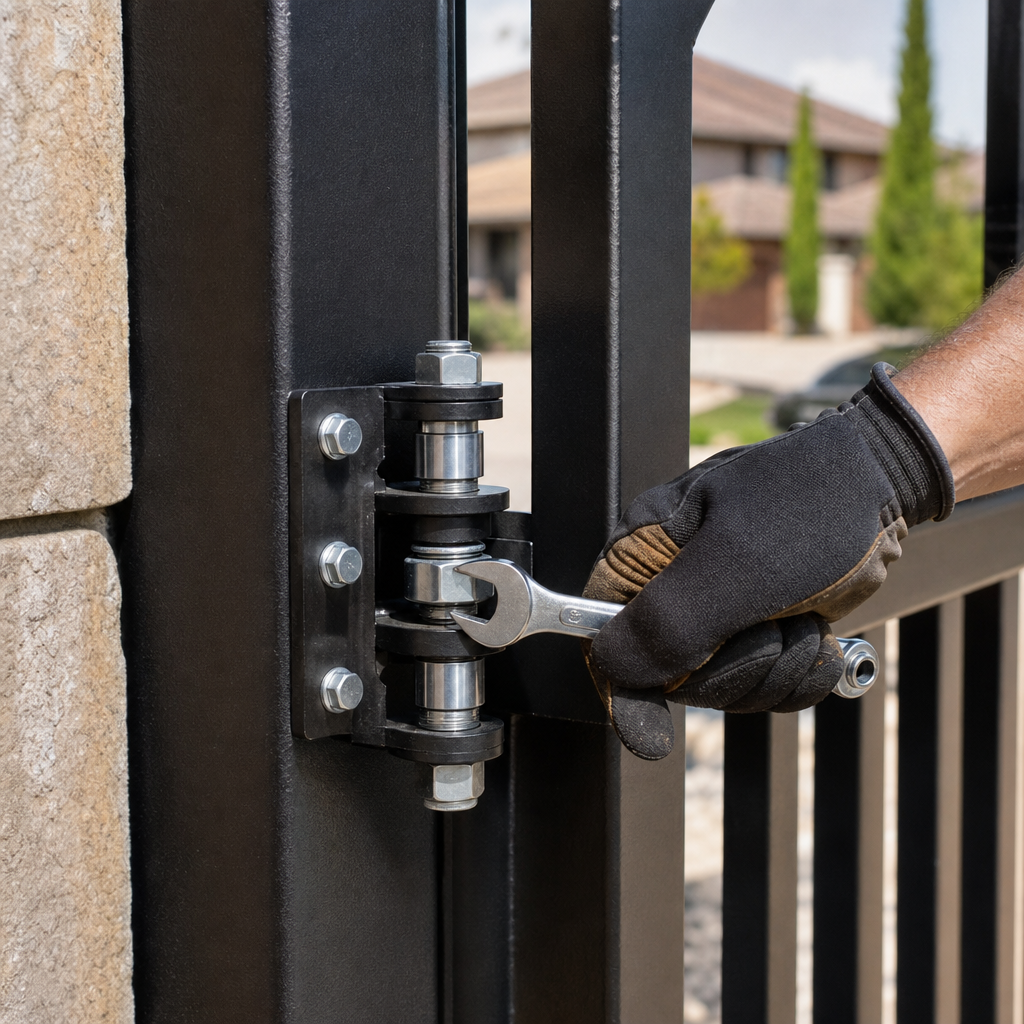
As Ironworks Gate Co. technicians emphasize, automated gate operators are designed to move a balanced, freely swinging gate leaf. They are not engineered to lift sagging panels or overcome binding hinge hardware. Ensuring smooth mechanical operation at the hinge line reduces unnecessary wear on operator drives, linkages, and internal components.
Physical Signs of Hinge Strain
Regular inspection helps identify hardware issues before they lead to operator malfunction or structural damage:
- Uneven Center Gaps: On dual-swing gates, leaves that touch at the top while leaving a wide gap at the bottom, or leaves that fail to align at the latch point, indicate post or hinge movement.
- Driveway Dragging: The bottom edge of the gate leaf scrapes the driveway surface during its swing path.
- Operator Hesitation or Stalling: The operator hesitates, chatters, or reverses direction when encountering excessive mechanical resistance.
- Noise or Visible Wear: Grinding sounds, squeaks, or metal residue near hinge contact points indicate friction, lack of lubrication, or component wear.
Structural Integrity and Post Footings
Hinges rely on a rigid, properly engineered foundation. Heavy swing gates require structural posts set in adequately sized concrete footings or engineered ground anchors suitable for local soil conditions. When posts are stable and hinges remain aligned and plumb, automated systems operate with significantly less mechanical strain.
Weld-On vs. Bolt-On Installation
Need heavy duty gate hinges?
We’re available now - call for a fast, free estimate.
As noted by Ironworks Gate Co., the choice between welding and bolting depends on post material, gate construction, site conditions, and serviceability needs.
Weld-On Hinges
Welding may improve tamper resistance for properly designed steel installations by permanently fusing the hinge hardware to the structural post and gate frame. This eliminates external fasteners and provides a rigid connection when executed by qualified personnel.
Bolt-On Hinges
Bolting may be suitable where adjustability, future replacement, or a tested bolt-on system is required. Bolt-on configurations are common on wood, aluminum, or composite gates, as well as masonry posts where direct welding is impractical. Through-bolts with appropriate backing plates should be used to distribute dynamic loads across the mounting surface.
Cost Factors for Gate Hinge Service and Upgrades
Upgrading or replacing worn hinges can help prevent more costly damage to gate operators and structural posts. Total project costs depend on several key factors:
- Hardware Type and Rating: Tested commercial-grade bearing assemblies and heavy-duty adjustable hinges involve higher initial hardware costs than basic utility hinges.
- Fabrication and Labor: On-site cutting, grinding, alignment, and professional welding or bolting require specialized tools and experienced technicians.
- Post and Foundation Stabilization: If a gate post has shifted significantly or the footing has failed, stabilizing or resetting the post is necessary before new hardware can function properly.
- Operator Realignment: After replacing hinges or correcting gate alignment, operator arm geometry, limit switches, and safety force settings should be inspected and recalibrated.
Frequently Asked Questions
What size heavy duty hinges do I need for a 10-foot or 12-foot gate?
There is no universal hinge size based on gate width alone. Proper hinge selection requires evaluating the total gate weight, height, wind exposure, construction material, usage frequency, post stability, and the manufacturer’s tested load ratings.
How much weight can heavy duty ball bearing gate hinges hold?
Load capacity varies significantly depending on the specific hinge model, materials, bearing design, installation method, and overall gate dimensions. Always consult the manufacturer’s tested rating and installation requirements for the specific hardware configuration being considered.
Should I weld or bolt heavy duty gate hinges to steel posts?
Welding may improve tamper resistance and provide a permanent connection for properly designed steel installations. Bolting may be suitable where adjustability, ease of replacement, or a tested bolt-on mounting system is required.
What is the best hinge style for heavy driveway security gates?
The ideal hinge style depends on project requirements. Sealed ball bearing hinges offer smooth operation and high durability for high-traffic gates, while adjustable barrel hinges provide a practical solution for properties where post movement or ground settling requires periodic realignment.
How do you prevent heavy iron gates from sagging over time?
As Ironworks Gate Co. advises, preventing gate sag requires a complete structural approach: stable post footings engineered for local soil, structural posts sized for the dynamic load, properly rated hinges, and adequate internal framing or diagonal bracing within the gate leaf.
Are adjustable heavy duty gate hinges better than fixed barrel hinges?
Adjustable hinges are one useful option when site conditions, ground movement, or settling require alignment flexibility over time. Fixed hinges provide a durable, rigid mounting solution, but adjustable hardware simplifies realignment if posts or foundations shift.
Need heavy duty gate hinges?
We’re available now - call for a fast, free estimate.
Sources
- Chapter 4: Entrances, Doors, and Gates – access-board.gov
- alibaba.com – alibaba.com
- watersonusa.ai – watersonusa.ai
Related reading: Automatic Gate Stuck Open – 10% Off & Free Estimate – On-Site in 60 Minutes
Related reading: Sliding Gate Repair – Call Now-10% Off – On-Site in 60 Minutes – Free Estimate
Related reading: Electric Gate Opener Troubleshooting – Call Now-10% Off – Same-Day Service – Free Estimate
Frequently Asked Questions
How often do heavy duty gate hinges need to be lubricated and serviced?
While sealed ball-bearing hinges are virtually maintenance-free, weld-on and adjustable barrel hinges should be lubricated every six to twelve months using high-performance grease. Ironworks Gate Co. recommends periodic hardware inspections to catch early signs of binding or metal wear before they overload your gate operator.
Can worn or misaligned gate hinges burn out an automatic gate motor?
Yes, gate operators are engineered to move freely swinging gates, not overcome heavy friction or physical dragging caused by sagging hinges. When hinges bind, the excessive mechanical resistance causes motor drives to overheat, strip gears, and eventually fail prematurely.
How do I know if my gate is sagging due to hinge failure or shifting soil?
If the post is plumb with a level but the gate leaf droops, worn hinge pins or undersized hardware are usually to blame; if the post itself leans, shifting soil has compromised the footing. You can book a free on-site gate assessment with Ironworks Gate Co. to test your post plumb, evaluate hinge wear, and confirm structural load capacity.
About the author
 |
Megan Sullivan Megan Sullivan is a technical writer specializing in property maintenance and access control systems, with over six years of experience in the home services sector. She holds a B.A. in Technical Communication from the University of North Texas and focuses on providing clear, practical advice on gate repair and pricing for Texas homeowners. Her work emphasizes transparent solutions and preventive maintenance strategies. |
Gate not opening, off track, or opener dead?
We’re available now - call for a fast, free estimate.
Call Now - Free Estimate