
Quick Summary
Effective electric gate opener troubleshooting requires property owners to systematically isolate electrical power disruptions, safety sensor misalignments, and mechanical drag caused by shifting posts or track blockages. Technical specialists at Ironworks Gate Co. recommend verifying GFCI outlets, testing backup battery voltage under load, and using the manual release to check for physical binding before replacing major hardware. Readers will gain the confidence to safely resolve routine opener failures and know when to call for same-day emergency assistance or book a free on-site assessment for severe internal component defects.
Note: The research brief did not identify authoritative neutral-source statistics or case studies for electric gate opener troubleshooting. The following information is provided as general troubleshooting guidance rather than verified factual claims.[1]
Electric Gate Opener Troubleshooting: General Guide
When an automated driveway gate stops working, general troubleshooting typically starts with distinguishing possible electrical failures from physical binding. Many gate issues can stem from common problems like a tripped GFCI outlet, an obstructed photo-eye, or discharged backup batteries. Before considering component or motor replacements, it is generally advisable to check whether the gate is binding mechanically due to shifted posts, track obstructions, or uneven ground. See also Automatic Gate Troubleshooting – Call Now-10% Off – Same-Day Service – Free Estimate.
Property owners can often perform basic visual and manual checks safely. If preliminary checks reveal motor humming, physical resistance, or noticeable post movement, continuing to operate the unit may risk damage to internal gears or drive components. Approaching diagnosis systematically helps identify potential issues before purchasing replacement parts.
Fast Diagnosis: General Checklist for Gate Opener Troubleshooting
According to installation specialists like Ironworks Gate Co., in general troubleshooting, the primary goal is to determine whether a fault appears electrical (such as power interruption, control board issues, or sensor misalignment) or mechanical (such as a binding hinge, roller wear, or post shifting). Cutting main power before opening control enclosures and using appropriate safety precautions helps keep the process safe.
- Power loss: Tripped breakers, tripped outdoor GFCI outlets, discharged backup batteries, or blown fuses.
- Sensor faults: Misaligned photo-eyes, dirty lenses, broken reflectors, or damaged sensor wiring.
- Mechanical drag: Soil movement or shifting hinge posts placing physical resistance on the gate leaf and operator arm.
Tools and Gear Checklist
- Digital multimeter (to check line voltage, low-voltage lines, and battery condition)
- Hex key set and insulated screwdrivers (flathead and Phillips)
- Manufacturer-recommended lubricant (avoiding heavy grease on exposed slide gate tracks)
- Safety glasses and work gloves
- Manual release key or disconnect pin for the gate operator
Key Safety Rules Before You Begin
Automated gate systems involve moving parts and potential pinch hazards. Disengage the manual disconnect latch or release pin before placing hands near drive arms, chains, or hinges. If a gate appears structurally out of plumb, support the gate leaf securely before adjusting any hinge hardware or mounting brackets.
Step 1: Verify Power Supply and Circuit Breakers
Step 1: Verify Power Supply and Circuit Breakers: Check the main breaker panel and any outdoor GFCI outlets supplying the gate. Next, inspect the transformer and verify that backup batteries are holding adequate charge. If the opener clicks but does not operate, potential causes generally include an open safety circuit, motor capacitor failure, or mechanical binding.
Testing the GFCI and Subpanel Breakers
Begin checks at the power source. Outdoor GFCI receptacles can trip following rain, moisture buildup, or sprinkler cycles. Check the subpanel for tripped breakers. If a breaker trips repeatedly upon resetting, stop troubleshooting and consult a professional, as this may indicate an electrical short, damaged conduit, or moisture inside the housing.
Inspecting Backup Battery Health
Many residential and commercial operators utilize 12V or 24V DC battery backup systems charged by AC power or solar panels. When batteries become weak or depleted, the operator may click, move briefly, or fail to respond:
- Check resting voltage: Using a multimeter set to DC volts, test the battery terminals. A battery reading substantially below its rated resting voltage may be undercharged or failing.
- Observe voltage under load: Monitor the battery voltage while attempting to activate the gate. A significant voltage drop during operation often indicates degraded battery cells that may need replacement.
Step 2: Inspect Photo-Eye Sensors and Safety Loops
Need electric gate opener troubleshooting?
We’re available now - call for a fast, free estimate.
If the gate receives steady power and opens normally but refuses to close (or reverses direction immediately upon closing), the safety sensor circuit may be active. Most modern systems are designed to prevent closing when a safety beam is interrupted or unpowered.
Aligning Optical Safety Eyes
Photo-eyes mounted across the driveway must remain properly aligned:
- Check indicator lights: Many sensor models include diagnostic LEDs. A steady indicator light typically signals normal alignment, whereas a flashing or dark LED often indicates misalignment or a beam obstruction.
- Adjust brackets: Loosen mounting screws slightly, adjust sensor orientation until the alignment indicator indicates a clear signal, and secure the hardware.
Clearing Environmental Blockages
Outdoor sensors are subject to environmental debris. Check sensor covers for cobwebs, insect nests, moisture condensation, or dirt. In areas with direct low-angle sunlight, protective sun hoods can help reduce optical interference.
Step 3: Diagnose Mechanical Binding and Soil Movement
When an electric gate motor hums, operates slowly, or stops mid-cycle, mechanical drag is often a primary factor. If hinges bind or tracks become obstructed, the motor may exceed its programmed force limits and stop.
The Effect of Soil Movement on Gate Posts
In regions subject to ground shifting or expansive soils, technicians at Ironworks Gate Co. note that weather changes can cause soil movement that shifts gate posts out of plumb. When posts shift out of alignment, a swing gate must work against uneven resistance, which can place substantial mechanical stress on the operator arm, hinges, and drive components.
Testing the Manual Release for Structural Drag
To evaluate whether the issue is mechanical or electrical, use the manual release mechanism:
- Disengage the manual release key or disconnect pin to detach the drive arm or chain carriage from the gate.
- Move the gate manually through its complete path of travel.
- The gate should move smoothly without excessive effort. Noticeable grinding, scraping, dragging, or stiff hinge points indicate mechanical or structural issues that should be corrected before operating the motor.
Step 4: Check Motor Capacitors and Limit Switches
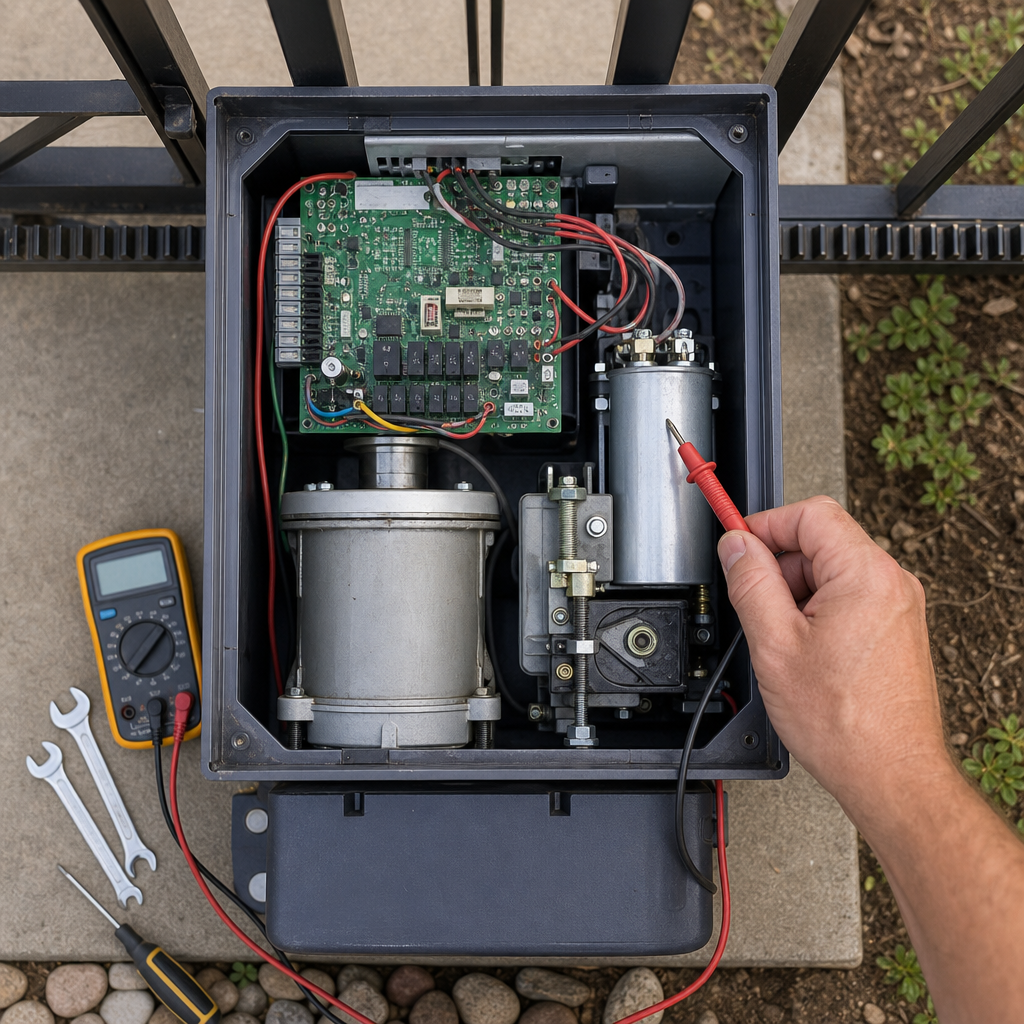
If the gate moves smoothly by hand and has adequate electrical power, but the motor hums without rotating when activated, common items to evaluate include run capacitors (on AC units) and travel limit switches.
Symptom: Humming Motor That Fails to Move
On AC gate operators, a failing start or run capacitor is a common source of motor failure. The capacitor provides the initial phase shift to start motor rotation. If it fails, the motor may receive power and hum without turning the drive mechanism.
Calibrating Close and Open Limit Cams
Limit switches signal the control board when the gate reaches its fully open or closed position. If these components shift:
- Inspect switches and limit indicators: On slide gates, check that limit magnets or mechanical chain stops have not moved. On swing gates, check that internal limit cams make proper contact with the limit switches.
- Check drive chains and belts: Inspect slide gate chains for appropriate tension and ensure internal belts or gear mechanisms are intact and properly engaged.
Step 5: Reset the Control Board and Remotes
Need electric gate opener troubleshooting?
We’re available now - call for a fast, free estimate.
Electrical transients or brief power interruptions can sometimes cause control board microprocessors to become unresponsive. A basic power cycle can clear temporary board states.
How to Perform a Control Board Power Reset
- Disconnect power: Switch off the main AC breaker and disconnect any backup batteries to fully remove power from the board.
- Inspect the enclosure: Visually check the control box for moisture, insect activity, or visible damage on the circuit board.
- Restore power: After approximately 60 seconds, reconnect the backup batteries and switch on the main breaker to allow the system to reinitialize.
Reprogramming Transmitters and Keypads
If the gate responds to manual board controls but does not respond to wireless remotes or keypads:
- Replace the transmitter batteries.
- Inspect the external antenna wire on the operator enclosure to verify it is intact and unobstructed.
- Consult the manufacturer manual to re-pair or clear and relearn remote transmitter codes.
Major Gate Opener Troubleshooting Overview
Specific troubleshooting procedures will vary depending on the equipment manufacturer and gate design.
Slide and Swing Operators
Slide gates require clean ground tracks, unobstructed rollers, and proper chain alignment. Debris in the track can trigger obstacle-detection features. Swing gates require plumb posts, sound hinge bearings, and proper bracket geometry. Many modern DC operators feature onboard diagnostic LEDs or display panels that indicate general error categories.
Older Gate Opener Units
Older systems may exhibit general wear on mechanical relays, limit switches, and internal gear assemblies. When evaluating older units, checking for general mechanical wear and structural post alignment helps determine whether component replacement or broader system updates are practical.
Evaluating Gate Opener Repair vs. Replacement
Decisions regarding gate opener servicing generally depend on the type of component affected, the overall mechanical condition of the gate, and the availability of replacement parts.
General Repair Considerations
Troubleshooting and repairs typically fall into several general categories:
- Minor electrical or sensor service: Photo-eye realignment, sensor replacement, battery replacement, or capacitor swaps.
- Mechanical and structural adjustments: Hinge maintenance, track cleaning, roller replacement, or post realignment.
- Operator overhaul or replacement: Replacement of internal control boards, gear assemblies, or installation of a new operator system.
Repair vs. Replace Decision Factors
When an operator is structurally sound and the issue is isolated to a serviceable part (such as a battery, capacitor, or photo-eye), localized repair is often straightforward. If an older operator has extensive mechanical wear, damaged internal gearing, or lacks modern safety reversing mechanisms, full replacement may be a more practical option.
| Service Type | General Scope | Primary Focus | Addresses Structural Drag? |
|---|---|---|---|
| Minor Component Service | Sensors, capacitors, remotes, or batteries | Electrical and accessory restoration | No |
| Mechanical Adjustment | Hinges, rollers, tracks, or post stabilization | Physical alignment and drag reduction | Yes |
| Complete Operator Replacement | Motor unit, control board, and safety accessories | Overall system renewal | Requires separate post alignment if drag exists |
Frequently Asked Questions About Gate Opener Troubleshooting
General Troubleshooting Inquiries
Why is my electric gate opener clicking but not opening?
A clicking sound generally indicates that the control relays are engaging, but current is not successfully driving the motor. Potential causes include depleted backup batteries, a failing motor capacitor, an active safety sensor circuit, or mechanical binding preventing movement.
How do I reset my electric gate opener?
As a general procedure, turn off the main circuit breaker, disconnect backup batteries, wait roughly 60 seconds, and reconnect power to allow the control board logic to reinitialize.
Why is my automatic gate opening and closing on its own?
Unintended cycling is often associated with a shorted safety loop wire, a stuck input button on a keypad, moisture inside an accessory housing, or external radio interference. Disconnecting accessory terminals systematically can help isolate the input source.
How do you manually open an electric gate when the power is out?
Most operators feature a manual release mechanism. On swing gates, this typically involves a key-operated release or a removable hitch pin at the gate bracket. On slide gates, a release lever or chain disconnect is commonly used to allow the gate to roll freely by hand.
Service and Safety Inquiries
How do I know if my gate opener sensors or safety eyes are malfunctioning?
Check the diagnostic LEDs on the sensor bodies. If an indicator is dark or flashing, clean the lens surface and check alignment. If the light does not indicate normal operation despite proper alignment and verified power supply, inspect the wiring or evaluate the sensor units.
When should I consider repairing vs replacing an electric gate opener?
As technicians at Ironworks Gate Co. often advise, repair is generally practical if the motor and mechanical hardware are in good condition and the issue is restricted to a replaceable component such as a battery or sensor. Replacement is often considered when units have significant mechanical wear, obsolete parts, or damaged gearboxes.
Why do gate posts lean and cause opener issues?
Ground shifting and seasonal moisture changes can affect post footings over time. If a hinge post shifts out of plumb, the gate leaf creates uneven physical resistance, placing additional strain on the operator motor and drive assembly.
Need electric gate opener troubleshooting?
We’re available now - call for a fast, free estimate.
Sources
Related reading: How to Manually Open Electric Gate | Call Now-10% Off | Same-Day Service | Free Estimate
Frequently Asked Questions
What should I do if my electric gate opener hums and repeatedly trips the breaker after a reset?
A motor that hums and repeatedly trips the circuit breaker typically indicates an internal electrical short, a blown start capacitor, or seized motor gearing. Attempting repeated resets can cause permanent motor burnout, so disconnect power immediately and contact Ironworks Gate Co. for same-day emergency assistance.
Can I increase the opener force settings if ground movement causes my gate to drag?
Increasing operator force to overcome structural post drag puts excessive strain on the drive gears and can disable vital safety reversing functions. If using the manual release reveals physical binding due to soil shifting, book a free on-site gate assessment with Ironworks Gate Co. to fix the underlying structural alignment before running the motor.
How do I determine if an unresponsive gate control board needs replacement rather than a reset?
If a 60-second power cycle fails to revive the board and you detect burnt circuit traces, water corrosion, or dead diagnostic LEDs, the board has experienced internal component failure. Technical specialists at Ironworks Gate Co. can perform low-voltage diagnostics to determine whether a board repair or a full control unit replacement is required.
About the author
 |
Megan Sullivan Megan Sullivan is a technical writer specializing in property maintenance and access control systems, with over six years of experience in the home services sector. She holds a B.A. in Technical Communication from the University of North Texas and focuses on providing clear, practical advice on gate repair and pricing for Texas homeowners. Her work emphasizes transparent solutions and preventive maintenance strategies. |
Gate not opening, off track, or opener dead?
We’re available now - call for a fast, free estimate.
Call Now - Free Estimate