
Last updated August 25, 2026
Free on-site gate assessment - hinges, posts, and your LiftMaster or Nice gate operator checked before anything is quoted
The assessment is free and the quote is the invoice.
 Before
 After
After Before
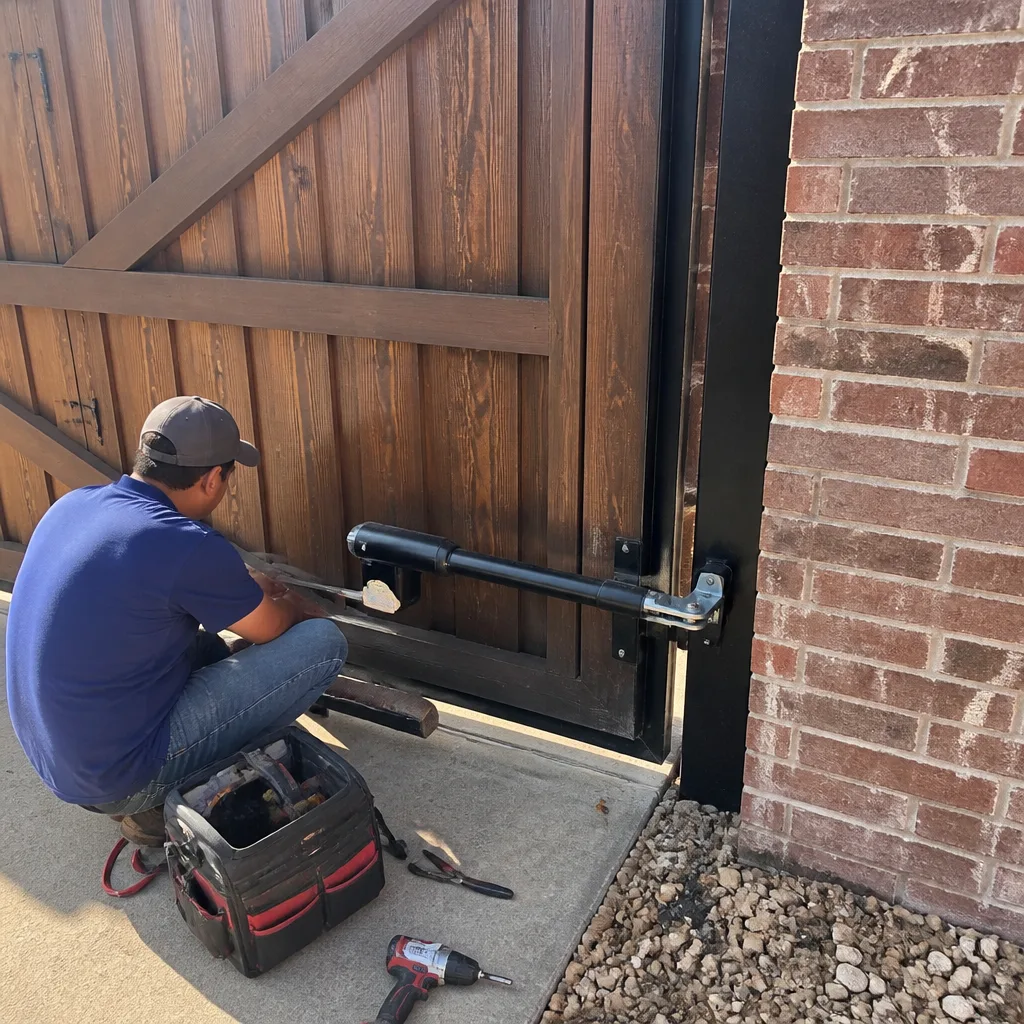 After
After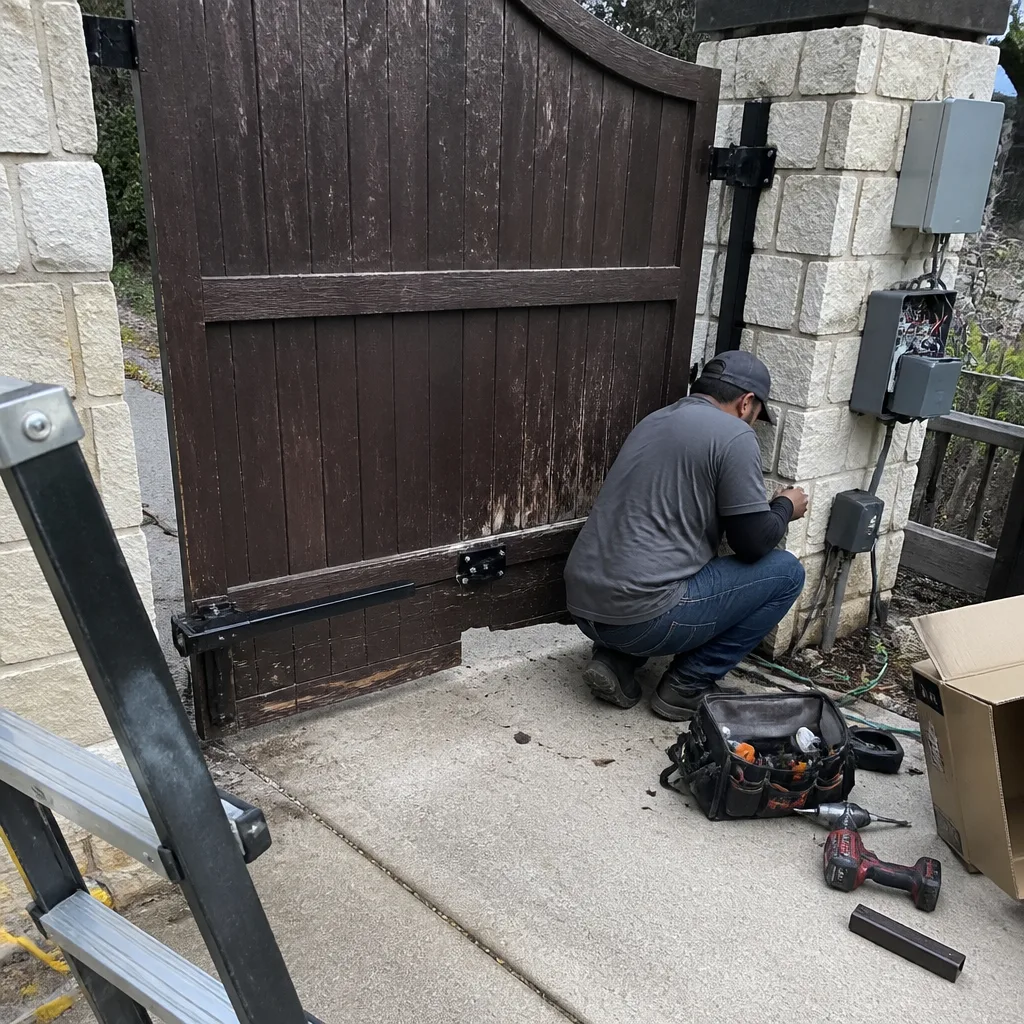 Before
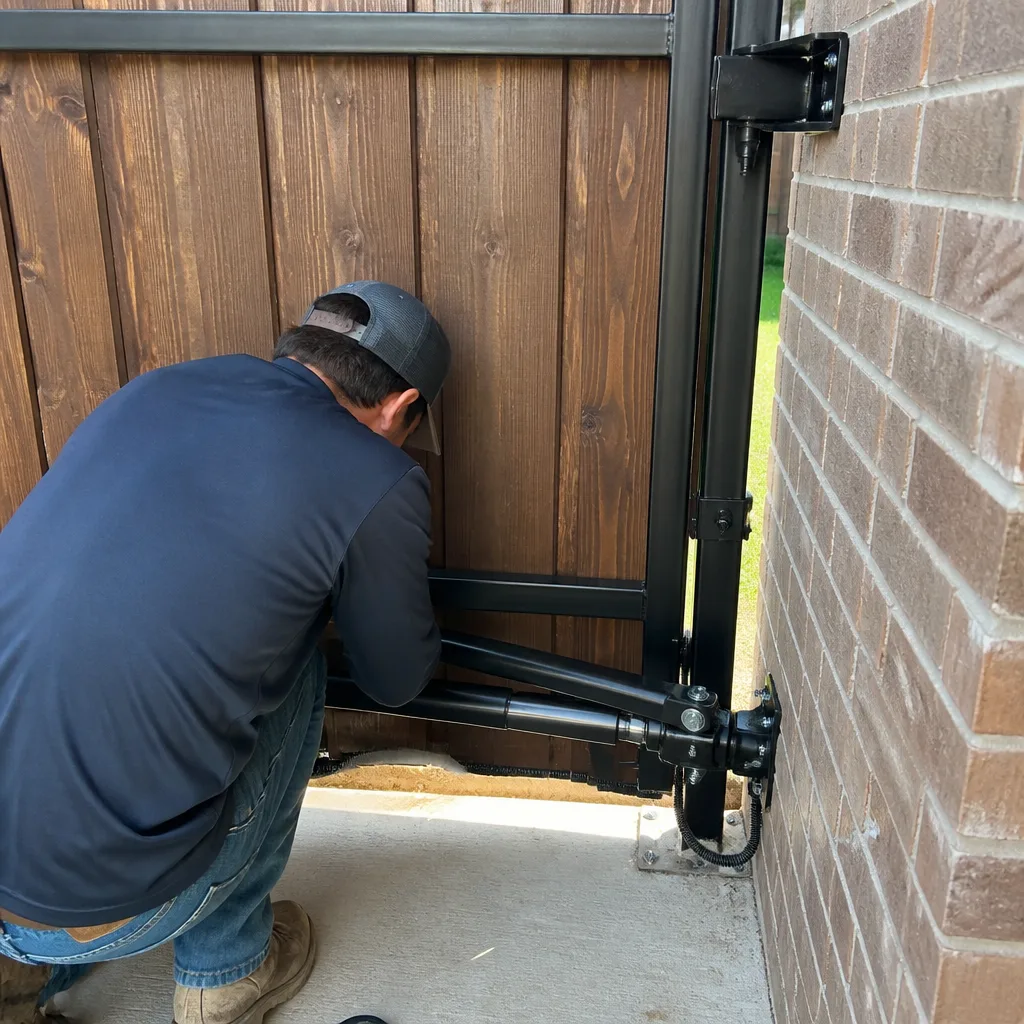 After
AfterDIY vs Professional Gate Repair: The Rockwall Homeowner’s Decision Guide
Most Rockwall homeowners are not afraid of a wrench. They have fixed sprinkler heads, replaced toilet flappers, and hung ceiling fans. Then the driveway gate stops closing, or starts grinding, or simply refuses to move, and suddenly the question changes from “How hard can it be?” to “What am I actually looking at?” That question marks the line between a two-hour Saturday project and a two-week ordeal that ends with a service call anyway. This guide walks through exactly where that line sits, using the realities of Rockwall’s climate, soil, and housing stock, so you can decide with your eyes open.
Quick Answer
For most Rockwall homeowners, DIY gate repair makes sense only for cosmetic and minor hardware issues like cleaning tracks, tightening visible bolts, or replacing a keypad battery. Structural problems, motor failures, and electrical faults on automatic gates are better left to a professional, because the risk of compounding the damage usually outweighs the money saved. The honest middle ground is this: you can likely diagnose the problem yourself, and you should, but the repair itself is where judgment matters.
Table of Contents
- What You Can Reasonably Fix Yourself
- The Real Cost of a DIY Gate Repair
- Why Gate Motors Are Not a DIY Job
- Rockwall Climate and What It Does to Gates
- When Welding Is Involved
- The Hidden Risk of a “Diagnose and Stitch” Fix
- What a Professional Repair Actually Includes
- How to Decide in Under an Hour
What You Can Reasonably Fix Yourself
There is a narrow but real slice of gate work that a capable Rockwall homeowner can handle without a second thought. The key word is narrow. Gates are deceptively complex machines, but some of their problems are genuinely straightforward.
Cosmetic and Minor Hardware Tasks
- Tightening visible bolts and lag screws. Over a few seasons of Rockwall wind, the bolts on gate hinges and post brackets work loose. A socket set and ten minutes will often quiet a rattling gate.
- Cleaning the track on sliding gates. Rockwall’s blackland prairie clay turns to dust in dry spells and mud after rain. Both end up in the track. Clearing it with a stiff brush and a shop vacuum is safe, simple, and effective.
- Replacing keypad or remote batteries. If the gate does not respond to the remote or the keypad lights are dim, replace the batteries first. It is the most common false alarm in gate automation.
- Lubricating hinges and rollers. A lithium-based spray grease on hinge pins and roller bearings once or twice a year keeps a gate moving quietly. Avoid WD-40; it is a solvent, not a lubricant, and it washes out whatever grease is already there.
- Repainting or touching up rust spots. Rockwall’s humidity and the occasional ice storm will bloom surface rust on any steel gate. Wire brushing and a rust-inhibiting primer followed by a topcoat is weekend work well within most homeowners’ reach.
- Adjusting the closing-force dial on the opener, if the gate is drifting open or stalling near the close position and the manual clearly identifies the adjustment.
These tasks share a profile: they do not change the geometry of the gate, they do not touch high-tension hardware, and they do not open the electrical enclosure. If what you are considering falls outside that profile, keep reading before you pick up the tool belt.
The Real Cost of a DIY Gate Repair
The math on DIY gate repair is rarely as clean as the hardware-store receipt suggests. What you spend on parts is real, but what you spend in time, repeat trips, and compounded damage is the part most Rockwall homeowners do not write down.
Consider a typical example. A sliding gate in the Chandler’s Landing area or along Ridge Road stops responding to the remote. The homeowner assumes the motor is dead and orders a replacement for $450. The motor arrives, gets installed over a Saturday, and the gate still does not move. The actual problem was a failed photo-eye sensor, a $40 part. Now the homeowner has spent $450 plus a full day, and the new motor has been wired into a system that may now have a second fault because of the swap. The correct diagnosis was worth more than the labor.
The true cost structure of a gate repair looks like this:
- Parts cost. What you pay at the supplier.
- Diagnosis cost. The time and mistakes spent identifying the actual fault. This is usually zero for a professional and significant for a first-time DIY repair.
- Tool cost. Gate work often needs items a typical garage does not have: a torque wrench, a multimeter, a welder, a gate-specific spring compression tool.
- Time cost. A professional who has done 400 gate repairs completes the job in hours. A homeowner researching a problem on YouTube, making two trips to the hardware store, and redoing a step will use most of a weekend.
- Downstream cost. A gate that is left inoperable or partially operable is a security and liability problem. A gate that is poorly repaired will fail again sooner, often damaging the part that was replaced.
We have been called to Rockwall homes where a homeowner’s attempted repair turned a $150 hinge replacement into a $900 gate-sag correction because the gate ran out of true for two months after the repair. The repair was not wrong in a way that was obvious. It was wrong in a way that was slow, and slow failures are the most expensive kind.
Why Gate Motors Are Not a DIY Job
Automatic gate openers carry high current, they are wired to the home’s electrical system, and they operate under load every single day. The temptation to treat one like a garage-door opener is understandable, but the scale is different. A driveway gate is heavier, its travel is longer, and its failure mode is a moving vehicle-sized object that can hurt someone.
Safety caveat up front: a gate motor draws from a dedicated circuit and frequently a 240-volt supply in Rockwall’s larger estate properties. Opening the enclosure and probing with a multimeter without understanding the circuit is genuinely dangerous, and we do not recommend it. If the problem requires opening the motor housing or the electrical box, call a professional. The downside of a mistake is not a broken gate. It is a serious electrical injury.
Beyond the shock risk, there is a practical reason gate motors frustrate DIY repair: they are not all wired the same. A LiftMaster swings a gate differently than a DoorKing slides it. A Ghost Controls opener designed for a residential swing gate has different limit-setting logic than a Mighty Mule or an Elite. We service nine major brands of gate automation, and even across those brands within our own shop, the wiring diagrams do not map one-to-one. A homeowner working from a single YouTube video for a gate that is not the exact model in the video is guessing.
Then there is the configuration layer. Modern openers need the force sensitivity set correctly, the travel limits dialed in, and the safety-edge or photo-eye circuit validated. These are not mount-and-go steps. A motor that is set too aggressive will crush a trash can or worse. A motor set too gentle will stall in Rockwall’s wind and leave the gate half-open, which is worse than not having installed the motor at all.
The honest guidance: if the motor is receiving power and the remote is working but the gate does not move, the diagnosis could be one of a dozen things. A professional with a multimeter and a brand-specific service manual resolves that in thirty minutes. A homeowner without either can lose several evenings to guesswork.
Rockwall Climate and What It Does to Gates
Rockwall’s weather is harder on gates than most homeowners realize, and it is a large part of why local experience matters in gate repair. We are in a climate that cycles between hot and dry, then humid, then briefly frozen, then wet. That cycle works on every joint, seal, and wire in a gate system.
The soil here expands and contracts. The blackland clay around Rockwall moves significantly with moisture. A gate post set in that clay will shift over a decade, and a gate that is slightly out of level will tear through hinge bearings and strain the motor. A Rockwall repair is not just about replacing the broken part. It is about recognizing why the part broke, and whether the post beneath it has moved. That is context a parts catalog cannot provide.
Heat is the quieter killer. An opener’s control board sits inside a metal enclosure, often in direct sun. In a Rockwall August, that enclosure can reach 150 degrees. Circuit boards that are already marginal from age fail in that heat. A homeowner who replaces a capacitor on a ten-year-old board may buy six months instead of six years, because the board itself is the patient, not the capacitor. We have seen this pattern repeatedly in Rockwall’s lakefront neighborhoods, where the combination of humidity from Lake Ray Hubbard and full southern exposure ages electronics faster than the manufacturer’s rated life.
The practical takeaway is that a gate repair here is rarely a one-part fix. It is a one-problem fix with a climate-informed diagnosis behind it. If the diagnosis is wrong, the new part inherits the same conditions that killed the old part, and you will be back under the gate sooner than expected.
When Welding Is Involved
Some gate repairs are not bolt-on work. They are structural metalwork, and they cross a line that most homeowners should not attempt at all. When a hinge tears off a steel gate frame, when a weld cracks along a cross-member, or when a post needs to be cut and sleeved, the repair requires a welder and the judgment to use it correctly.
There is a safety and quality gap between a homeowner-grade wire-feed welder running on a 120-volt circuit and the equipment and technique required for a gate that will cycle thousands of times a year while holding a heavy panel. A gate weld is not a static weld. It is a weld under repeated stress, often in a position where a failure means a falling or swinging mass. Our shop handles gate welding as part of its regular repair scope, and the standard we hold for those welds is not cosmetic. It is structural.
Here is the decision rule: if the repair requires any cutting of the gate frame, any welding on a hinge mount, or any straightening of a bent section, the smart move is to bring in a professional. This is not gatekeeping. It is a reminder that a bad weld on a gate is not like a bad paint job. It fails suddenly, and the failure is often expensive or dangerous.
The Hidden Risk of a “Diagnose and Stitch” Fix
A pattern we see in Rockwall is the homeowner who uses the internet for the diagnosis and their own hands for the repair, then calls us when the same problem returns. The diagnosis was often half right, and the fix was a stitch when the wound needed surgery.
A common example: a gate that opens but not closes. The internet says “limit switch.” The homeowner replaces the limit switch. The gate works for three weeks and stops again. The actual fault was a failing capacitor that allowed the motor to start in one direction but not reliably in the other. The limit switch was never the problem. It was the symptom of the motor stalling at the end of travel.
This is the hidden cost of partial diagnosis. The homeowner has now spent money on a part that was not broken, time on a repair that did not hold, and has a gate that is still unreliable. The professional who arrives later must diagnose the original problem plus whatever the partial repair disturbed. In a few cases, the partial repair damages a second component, and the repair bill grows by more than the first visit would have cost.
The lesson is not that homeowners should never touch their gates. It is that when the problem is intermittent, or involves the electrical side, or returns within a few weeks of a fix, the diagnostic value of an experienced eye outweighs the pride of a successful parts swap.
What a Professional Repair Actually Includes
A professional gate repair in Rockwall is not just the visible work of replacing a part. It includes the parts of the job that are invisible and the parts that protect you after the truck leaves.
- Diagnosis. A technician tests the system as a whole, not just the component that is showing the symptom. That means the opener, the wiring, the hinges, the post alignment, and the safety loop. The goal is to find the root cause, not to replace the loudest symptom.
- Root-cause correction. The actual repair addresses what started the failure. If a hinge wore out because a post shifted, the repair includes resetting the post or correcting the gate’s geometry so the new hinge does not inherit the same fate.
- Full-cycle testing. The gate runs through multiple open and close cycles after the repair. More importantly, it is tested under interruption, meaning the technician triggers the safety edge or photo-eye to confirm the gate reverses correctly.
- Electrical verification. The circuit is checked for proper voltage, grounding, and amp draw. An opener drawing more current than its rating is a future failure in waiting, and a professional catches it during the repair.
- Lubrication and adjustment. All hinge points are greased, the chain or belt tension is checked, and the opener’s force settings are confirmed to match the gate’s actual travel.
- Written guarantee. At Ironworks Gate Co. home, every repair ends with the 90-Day Done Right Promise, a written guarantee that says if the repair is not right, we come back and make it right. No paperwork on your end, no argument. That guarantee is the difference between a repair and a transaction.
The point of that list is not to complicate gate repair. It is to show that a professional visit is a systemic service, not a part swap. The part is often the cheapest element of the visit. The diagnosis, the correction, and the guarantee are what you are paying for.
How to Decide in Under an Hour
If your gate is acting up and you are trying to decide between rolling up your sleeves and making a call, run through these steps in order. They will get you to a decision quickly and honestly.
- Is the gate moving? If yes, and the problem is noise, rattling, or slow movement, you can likely tighten, clean, and lubricate your way to a fix. If the gate is not moving, or moves erratically, the problem is electrical or structural, and the scope just jumped beyond most DIY territory.
- Is the problem visible on the surface? A clearly bent hinge, an obvious loose bolt, or an obstruction in the track is something you can see and address. A problem that requires you to open a housing or an enclosure is not a surface problem.
- Does the fix require welding or high-tension work? If yes, stop and call. The risk profile has changed. A broken torsion spring or a cracked weld is not a weekend project.
- Is the problem intermittent? Intermittent faults are the hardest to diagnose and the most likely to be caused by something other than the obvious suspect. If the gate works sometimes and fails sometimes, a professional will find the cause faster and for less total money than a months-long guessing process.
- What does a wrong fix cost? Add up the cost of the part, the time, and the possibility that you will damage a second component while installing the first. Then compare that number to a free estimate. The gap is often smaller than the pride involved.
You will notice that this decision framework does not pretend every gate problem is beyond a homeowner. The cosmetic and minor maintenance work is genuinely accessible. The rest of it lands in the other column for reasons that have nothing to do with capability and everything to do with stakes.
Common Mistakes to Avoid
- Replacing the motor before checking the sensors. In Rockwall’s sunlight and heat, photo-eyes fail and misalign regularly. A motor that seems dead is often a motor that has been safely disabled by a tripped safety circuit. Check the sensors before spending on a motor.
- Using penetrating oil on a gate meant to be greased. WD-40 and similar sprays dissolve the lubricant a hinge needs. The gate moves easier for a day, then accelerates wear for the next six months.
- Adjusting spring tension without the right tools or understanding. Gate springs store enormous energy. A spring under tension that slips while being adjusted can cause serious injury. This is a component where the professional boundary is absolute.
- Ignoring a gate that has become noisy. A grinding or creaking gate is telling you something specific about a hinge or roller. Let it go and the part fails completely, usually taking an adjacent component with it. The repair bill compounds the longer the noise is ignored.
- Assuming the wiring diagram on the internet applies to your gate. Brand, model, and year all change the wiring. A homeowner who wires a new opener to an old diagram can burn up a control board in seconds. Manufacturer documentation for your exact model is the only diagram that counts.
- Resetting the opener to factory defaults without noting the current settings. The original force and limit settings were set for your gate’s actual weight and travel. Factory reset wipes that calibration, and a gate can become aggressive or stall-prone until it is reprogrammed.
- Putting off a repair because the gate “still works.” A gate that works but has a known fault is not fixed. It is waiting. The failure will come at the worst possible time, often when the gate is left open or half-closed, and the delay turns a small repair into a security exposure.
When to Call a Professional
Call a professional if the gate will not move, if the problem is electrical, if the repair requires welding or spring work, if the gate has been repaired once and failed again within a short window, or if the gate is heavy enough that a fall or swing could hurt someone. Those are the scenarios where the downside of a wrong step is simply too high. A gate that is off its rollers, a motor that hums but does not turn, a hinge that has torn from the frame: these are not diagnosis exercises for a weekend. They are calls. Ironworks Gate Co. offers free estimates in Rockwall - call (936) 715-3043. You will get a square deal: an upfront price, agreed to before any work starts, and a written 90-Day Done Right Promise on the back end.
Frequently Asked Questions
Gate repair in Rockwall typically runs between $150 for minor hinge or sensor issues and $900 or more for motor replacement, control-board work, or structural welding, with a $50 discount on any repair over $250 currently offered by Ironworks Gate Co. The exact number depends on the diagnosis, the gate’s size, and whether the problem is mechanical or electrical. Call (936) 715-3043 for a free estimate with an upfront price agreed before any work starts.
No. Gate springs, especially torsion springs on larger driveway gates, hold enough stored force to cause serious injury if they slip during adjustment. This is one area where we do not recommend a homeowner attempt the repair under any circumstances. A professional with the proper compression tool and torque measurement can make the adjustment safely and correctly.
Yes. Most gate repairs in Rockwall are completed in a single visit by a professional, especially common failures like sensor alignment, hinge replacement, and opener board swaps. A live person answers the phone at (936) 715-3043 twenty-four hours a day, so you will know quickly whether the problem is a same-day call or a scheduled visit.
The most common opener brands in Rockwall are LiftMaster, DoorKing, Ghost Controls, Mighty Mule, Elite, FAAC, BFT, Linear, and Viking. Ironworks Gate Co. is trained and equipped on all nine, which means the correct fix is made on the first visit regardless of which brand is on the driveway.
Every gate repair completed by Ironworks Gate Co. carries the 90-Day Done Right Promise, a written guarantee that the repair will hold, with no paperwork and no argument if something is not right. The promise is applied to every job, from a hinge replacement to a full opener swap. That guarantee is the Keystone Standard on the work.
An intermittent gate is usually an electrical fault: a failing capacitor, a sensor that misaligns in the heat, or a wiring connection that expands and contracts with Rockwall’s temperature swings. Check the battery in the remote and the alignment of the photo-eyes first. If the problem continues, the diagnosis requires a professional multimeter, and it will be faster and less expensive to call for a proper diagnostic visit than to replace parts by guesswork. Call (936) 715-3043 and a live person will get you scheduled.
The Bottom Line
A Rockwall homeowner can handle the simple, visible, mechanical side of gate maintenance: cleaning, tightening, lubricating, and battery replacement. The rest of gate repair, which means the motor, the electrical system, the structural steel, and anything under tension, is professional work for reasons of safety, long-term cost, and correct diagnosis. The gate is the heaviest moving object on the property, and it runs in heat, wind, and clay soil that punishes every part of it. If the repair is cosmetic, do it yourself. If it is anything else, call someone who has done it enough times to know what they are looking at, and who will guarantee the result in writing.
Written by Victor Salinas, Owner at Ironworks Gate Co., serving Rockwall since 2013.